Difference between PIJ and CIJ printer
Difference between PIJ and CIJ printer
Here is a clear and concise comparison between PIJ (Piezo Inkjet) and CIJ (Continuous Inkjet) printers, structured for quick understanding.
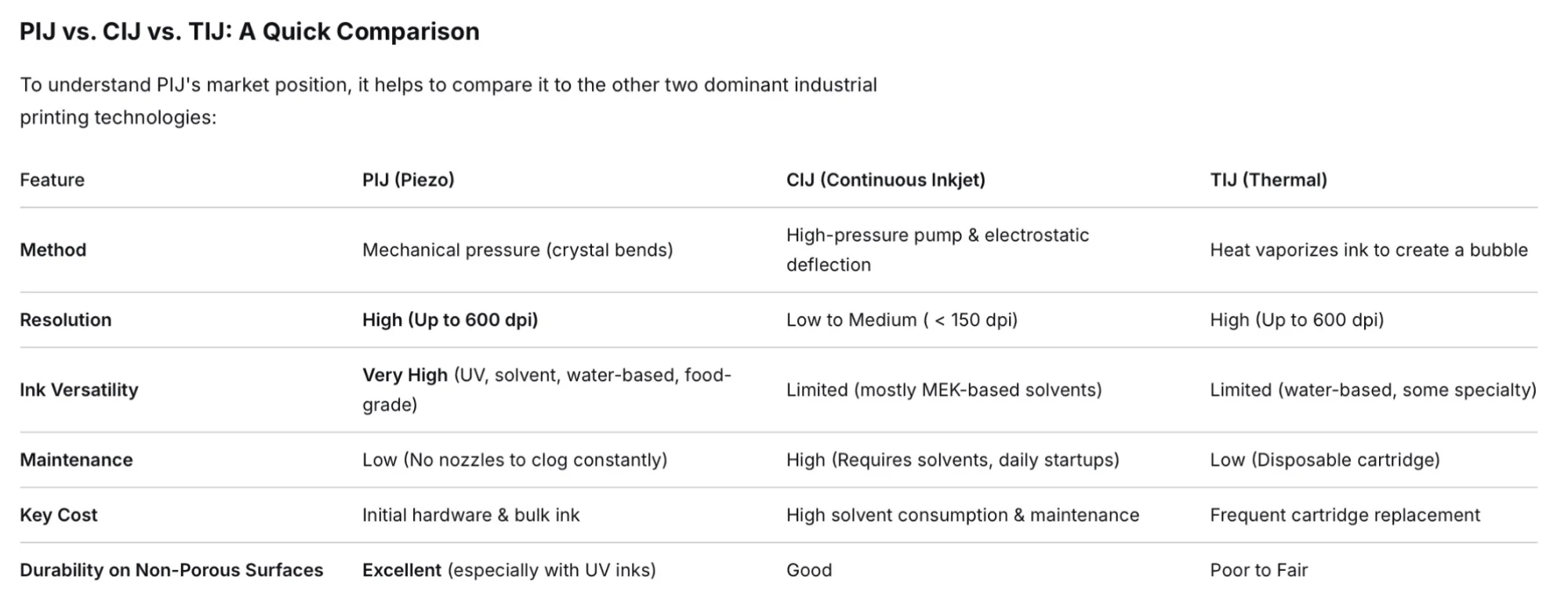
PIJ vs. CIJ: Key Differences
Aspect | PIJ (Piezo Inkjet) | CIJ (Continuous Inkjet) |
Working Principle | Drop-on-Demand: Ink ejected only when needed by piezoelectric crystal deformation | Continuous stream: Ink constantly flows; undeflected droplets are recycled |
Print Resolution | High (up to 600 dpi) – ideal for sharp text, logos, and dense 2D barcodes (QR, DataMatrix) | Low to medium (<150 dpi) – suitable for simple best-before dates and batch codes |
Print Distance | Must be close to the surface (within a few millimeters) | Can print from a distance (several centimeters), suitable for uneven or recessed surfaces |
Ink Consumption | Minimal waste – only printed ink is used; no solvents required | High consumption – requires continuous make-up fluids (thinner) |
Maintenance | Low – no nozzles to clog; easy cartridge replacement; no daily cleaning | High – requires regular cleaning; system flushing needed if idle |
Ink Versatility | Very wide – supports UV, water-based, solvent, and food-grade inks | Limited – mainly MEK-based inks with odor and ventilation requirement |
Environmental Impact | Better – no VOC emissions, low waste | Poorer – solvent evaporation and hazardous waste |
Long-term Cost (TCO) | Lower – no solvent cost, less maintenance downtime | Higher – ongoing solvent cost and frequent maintenance |
lQuick Selection Guide
ØChoose PIJ if you need:
ØHigh-resolution 2D barcodes for compliance (GS1, UDI)
ØPrinting on challenging materials (plastics, films, coated cartons)
ØLow maintenance and eco-friendly operation
lChoose CIJ if you have:
ØUneven product distances (e.g. recessed can bottoms)
ØSimple text-only coding requirements
ØExisting solvent handling infrastructure
This format delivers the essential information quickly while maintaining technical accuracy for professional buyers.