Cobot Palletizer vs Traditional Palletizing System: Which Is Better?
Cobot Palletizer vs Traditional Palletizing System: Which Is Better?
Why Palletizing Becomes a Bottleneck
In many packaging lines, palletizing is not limited by machine speed, but by upstream instability.
Common real-world conditions include:
• inconsistent carton spacing on conveyors
• mixed SKUs within the same shift
• fluctuating line speeds from filling or labeling processes
• limited buffer zones before palletizing
These factors determine whether a palletizing system performs efficiently in practice.
This is why comparing cobot palletizers and traditional palletizing systems requires looking at real production conditions, not theoretical performance.
Complete Comparison: Cobot vs Traditional Palletizing System
| Category | Key Parameter | Cobot Palletizer | Traditional Palletizing System | Practical Impact |
|---|
| Throughput | Nominal Speed | 4–8 cases/min | 10–25+ cases/min | Traditional faster under ideal conditions |
| Real Throughput Stability | High under variable flow | Drops under unstable flow | Cobot more stable in real lines |
| Input Requirement | Irregular acceptable | Must be continuous | Traditional requires buffering |
| Payload | Load Capacity | 5–25 kg | 20–100+ kg | Traditional for heavy-duty |
| Flexibility | SKU Adaptability | High | Low | Cobot suits multi-product lines |
| Changeover Time | 5–15 min | 30–120 min | Major downtime difference |
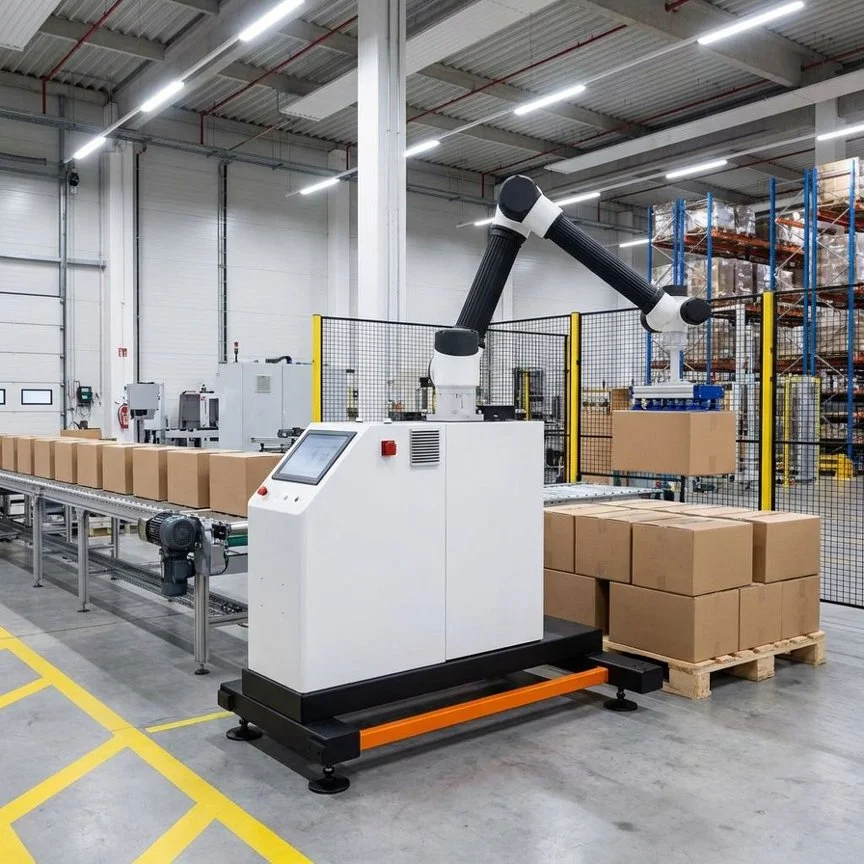
| Layout | Footprint | Compact | Large | Cobot fits existing lines |
| Integration | Deployment Time | 1–3 days | 2–6 weeks | Faster installation |
| ROI | Initial Investment | Lower | Higher | Entry barrier difference |
| ROI Driver | Flexibility | Scale | Depends on production type |
Throughput: Why Speed Alone Is Misleading
Traditional palletizing systems are designed to operate at high speeds under stable conditions.
However, this performance depends on:
• consistent product spacing
• continuous flow from upstream processes
• properly designed buffer systems
• In real production environments, these conditions are often not met.
When product flow becomes irregular, traditional systems may experience:
Cobot palletizers, while slower in nominal speed, are less sensitive to these variations and maintain more stable output.
Changeover: The Real Source of Downtime
Common triggers include:
Traditional palletizing systems typically require:
This results in longer downtime.
In practice, throughput depends more on production stability than maximum machine speed.
Layout and Space Constraints in Existing Factories
In existing facilities, space constraints often determine which system can be implemented.
Integration and Deployment: Engineering vs Modularity
Traditional palletizing systems require full integration with:
This increases:
• engineering complexity
• project duration
• implementation risk
Cobot palletizers are typically deployed as modular systems, reducing integration effort and enabling faster commissioning.
This difference directly affects project timelines and flexibility.
ROI Depends on Production Stability, Not Just Cost
ROI in palletizing is closely tied to how the system is used.
Poor ROI is often the result of choosing a system that does not match the production pattern.
When to Choose Each System
Choose a Cobot Palletizer if:
• product mix changes frequently
• upstream processes are not fully stable
• space is limited
• automation is being introduced gradually
Choose a Traditional Palletizing System if:
• production is continuous and stable
• product format is consistent
• high throughput is required
• full line automation already exists
Choosing the right palletizing solution starts with understanding your production needs. A well-matched system can significantly improve efficiency, reduce labor dependency, and support future growth.